What Is the Daily Call?
One chart. One daily filter. One clear way to avoid the wrong side of the market.
Trading mistakes often do not come from a lack of information.
They come from being on the wrong side of the day.
You may know this feeling.
The market is trending up.
You keep fading it.
You short again.
You get stopped again.
You try one more time because it “has to turn soon.”
Then the day ends and the obvious question appears:
Why didn’t I just go long?
Or even simpler:
Why did I keep fighting the market?
That is exactly the type of mistake the Daily Call is designed to reduce.
Not by predicting the future.
Not by giving signals.
Not by telling you what to buy or sell.
The Daily Call is a principle-based filter for the next trading day.
Its main job is not to tell you what to do.
Its main job is to help you avoid what not to do.
Get the free Daily Call on Telegram:
One chart. One daily call. One clear “what not to do” filter.

The Daily Call Is Like a Weather Forecast
Nobody knows the future.
But that does not mean we walk outside blind.
When the weather forecast says it will likely rain, you do not argue with the sky.
You bring an umbrella.
That does not mean it will rain with absolute certainty.
It means probabilities are stacked enough to prepare differently.
The market is no different.
If the Daily Call says the next day has a higher likelihood of sideways-to-up price action, the rule book becomes very simple:
Do not short the market.
That does not mean the market cannot go down.
It means the higher-quality decision is to avoid fighting the dominant expectation.
Simple?
Yes.
And that is the point.
Most traders do not need more complexity.
They need fewer avoidable mistakes.

Why This Matters
Many traders lose money not because they are stupid.
They lose money because the market is counter-intuitive.
In normal life, our instincts often protect us.
In trading, those same instincts often create the problem.
When a trade goes against us, we become hopeful.
When a trade gives us a small profit, we become fearful.
When the market trends strongly, we want to fade it.
When the market goes sideways, we want to force breakouts.
The market punishes intuitive reaction.
That is why principle-based trading matters.
A principle removes some of the emotional negotiation.
If the call is up, do not short.
If the call is down, do not long.
If the call is sideways, do not trade breakouts.
If the call is uncertain, do not force trades.
This is not glamorous.
It is better than glamorous.
It is useful.

The Daily Call Comes From Historical Market Work
We crunch a lot of historical data.
Not to create magic.
Not to create certainty.
But to stack probabilities.
The goal is to take the pulse of the market using 35 years of experience and principle-based market observation.
The result is a simple next-day filter.
A trader can then look at the market with one less emotional burden:
What should I avoid tomorrow?
That question alone can change a trading day.
Because sometimes the best trade is not the trade you take.
Sometimes the best trade is the mistake you do not make.

Example
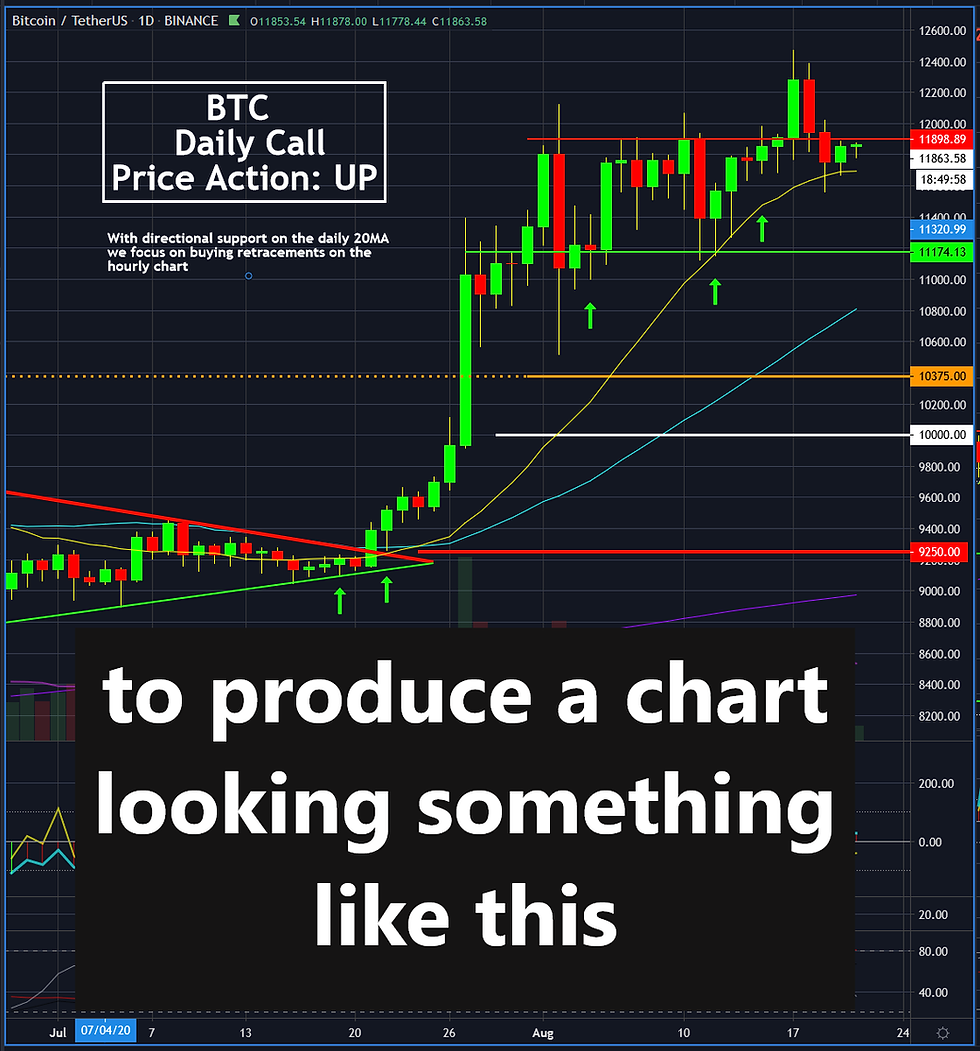
A Daily Call may look like this:
BTC
Daily Call
Price Action: Up
With directional support on the daily 20MA, the focus is on buying retracements on the hourly chart.
That is not a blind signal.
It is a framework.
The call tells you the directional filter.
The execution still belongs to your rules, your risk, your time frame, and your responsibility.
But the filter is clear:
If price action is up, the main avoidable mistake is shorting the market.
This alone can keep a trader out of unnecessary fights.
There Are Only Six Daily Calls
The Daily Call is intentionally simple.
There are only six possible outcomes:
Price Action: Up
Price Action: Sideways to up
Price Action: Sideways
Price Action: Sideways to down
Price Action: Down
Price Action: Uncertain
Each call creates a “do not do” rule.
Price Action: Up
Do not short the market.
Price Action: Sideways to up
Do not short the market.
Price Action: Sideways
Do not trade breakouts.
Price Action: Sideways to down
Do not long the market.
Price Action: Down
Do not long the market.
Price Action: Uncertain
Do not trade.
This is the whole point.
The Daily Call is not there to make you aggressive.
It is there to make you prepared.
Being risk-averse is one of the keys to longevity as a market participant.
When it rains, bring an umbrella.
When the market has a clear directional bias, stop fighting it.

Who This Is For
The Daily Call is for traders who already know that trading is not easy money.
It is for traders who have broken their own rules too many times.
It is for traders who understand that confidence does not come from hype.
Confidence comes from repeatability.
It comes from principles.
It comes from removing the same mistake again and again until your trading becomes lighter, cleaner, and less emotionally expensive.
Join the Free Daily Call
The Daily Call is free.
One chart.
One daily call.
One clear “what not to do” filter.
Want to make fewer avoidable trading mistakes?
Join the free Daily Call on Telegram:
Educational only. Trading involves risk. Not financial advice.
All information presented on this website and in the Telegram channel is for educational purposes only and is not intended to provide financial advice.
You are responsible for your own actions and trading results.
Comments