Gold

So much can be said about this shiny metal and its lure.
But I want to keep this entry brief.
Brief does not mean shallow.
This one is principle-drenched, and the timing matters.
I just repurchased gold.
Why?
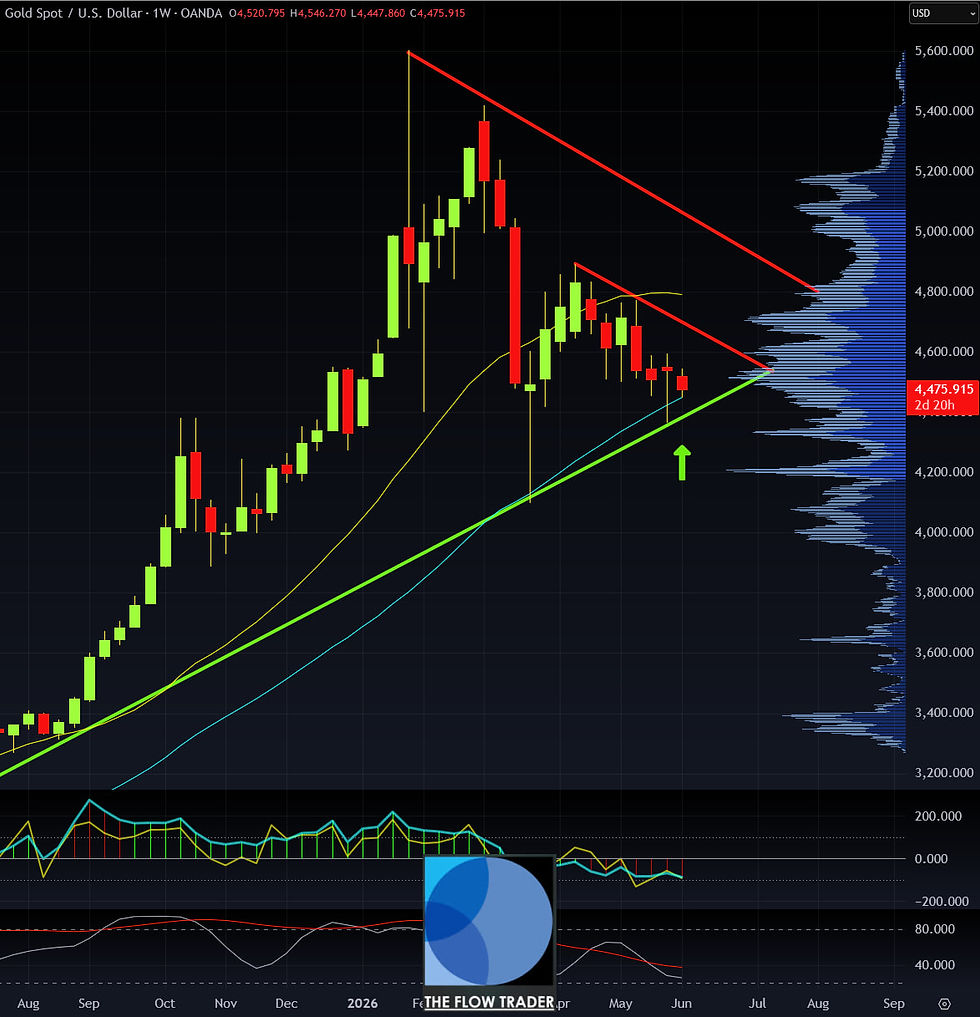
Because across various time frames, gold is showing an alignment that can support a bullish move.


Want the daily version of this thinking?
Start with the free principle-based PDF:
How to Make Fewer Avoidable Trading Mistakes
No email required.
No signup required.
Download it here:
The PDF also explains the free Telegram market note for traders who want the daily version.
Educational only. Not financial advice.
The setup is there.
The structure is there.
The possibility is there.
But, and this is a very large but:
A low-risk entry is not the whole game.
Many traders confuse a good entry with a complete plan.
It is not.
A good entry is only one piece of the equation.
Position size matters.
Time frame matters.
Liquidation risk matters.
Psychological pressure matters.
And most importantly, the difference between a trading position and a core position matters.
Most of you who care about gold already have some kind of core position.
And from a top-down perspective, the bigger question is not:
Should I buy gold today?
The bigger question is:
How much gold should I own?
That answer is personal.
But the principle is universal.
Own enough gold so it can protect you.
Do not own so much gold that the position owns you.
A typical hedge of 2% to 5% in physical gold is one thing.
A larger allocation is something else.
A larger allocation can be sensible in the right context, but it brings a different question:
Do I keep cash ready and buy more once markets have bottomed?
Or do I continue adding to my physical core position now?
There is no emotionally comfortable answer.
Cash has its own downside.
Inflation is one of them.
But physical gold has its own problem too.
It usually needs a longer time frame to achieve its purpose.
And selling physical gold should never be a reactionary decision during a steep market decline.
That is not what physical gold is for.
Physical gold is not there to be panic-sold into disorder.
It is there because paper promises eventually reveal their weakness.
Still, we need to be honest about the first phase of a market collapse.
If the market collapses, and we all know that the numbers no longer add up cleanly, gold may decline as well.
At least first.
That surprises many people.
They think:
If the system is in trouble, gold should go up.
In principle, yes.
But in the first phase of a market collapse, everything liquid can get sold.
Stocks get sold.
Crypto gets sold.
Bonds can get sold.
Gold can get sold.
Not because gold suddenly lost its purpose.
But because margin calls do not care about philosophy.
When investors, funds, and leveraged players are forced to raise cash, they sell what they can sell.
Precious metals can become a source of liquidity.
So gold can decline during the first wave of liquidation.
That does not invalidate gold.
It simply reminds us that timing, sizing, and liquidity matter.
The more time passes, the more likely it becomes that some kind of negative activator hits the markets.
That activator can be political.
It can be credit-related.
It can be geopolitical.
It can be something hidden until it suddenly becomes obvious.
And when confidence breaks, the decline can be brutal.
Not only in percentage size.
Also in duration of recovery.
Yes, precious metals may be among the first assets to recover.
But that does not remove the pain of the initial decline.
If you lose liquidity first, you may not emotionally or financially survive long enough to benefit from the later recovery.
That is why gold is not just about being right.
It is about being positioned correctly.
Our solution to this problem is not to double up blindly.
It is to think in bundles.
The physical position has one job.
The tactical position has another job.
The physical gold position is the long-term core.
It should be sized so that you can hold it without being forced into reactionary decisions.
The non-physical gold trade, for example through futures, has a different job.
It can be used as a tactical financing and risk-pressure tool around the physical purchase.
This is the important part.
If I buy physical gold, I am committing capital to something that should not be managed emotionally.
I do not want to sell it quickly.
I do not want to react to every market move.
I do not want the physical position to become a short-term trading problem.
But I can place a separate, smaller, non-physical gold trade when the technical setup supports it.
If that trade moves in my favor, I can take early partial profits.
For example, taking 50% of the trading position off early.
Those realized profits can then reduce the pressure of the physical purchase.
They can help finance the holding.
They can reduce the effective risk of the bundle.
They can give the physical position more breathing room.
This is not about doubling exposure recklessly.
It is the opposite.
The physical gold is the core.
The non-physical trade is the tactical helper.
The goal of the trading position is not to become greedy.
The goal is to harvest early profits when offered, reduce risk, and make the physical position easier to hold.
That is the bridge.
Physical gold needs time.
A non-physical gold trade can sometimes create the early realized gain that helps finance that time.
This is why early profit-taking matters.
It is not only psychological.
It can be structural.
If the tactical trade gives you profit early, and you remove part of the position, the whole gold bundle becomes lighter.
Less pressure.
Less fear.
Less need to make a reactionary decision.
You may have seen me use this strategy in the past.
Older blog entries show examples of this approach.
The principle is simple:
Do not let the long-term physical position become a short-term emotional problem.
Use the tactical trade to reduce pressure around the core.
If the tactical trade works, take profits early and let those profits help carry the physical position.
If the tactical trade does not work, it must be sized defensively enough that it does not damage the physical plan.
That is why the size of the non-physical trade matters.
It must support the bundle.
It must not endanger the bundle.
Gold is not magic.
Gold is a principle asset.
It has no counterparty risk when held physically.
It does not depend on a government promise.
It does not depend on a bank balance sheet.
It does not need a CEO, a board, an earnings report, or a rescue package.
That is why gold matters.
But even the right asset can become the wrong position if it is too large, too leveraged, or bought without a plan.
This is where traders and investors need to be honest.
Are you buying gold as a trade?
Or are you owning gold as insurance?
Those are not the same thing.
A trade needs an entry, an invalidation point, an exit plan, and risk control.
Insurance needs patience, emotional neutrality, and the ability to sit through volatility without being shaken out.
If you confuse the two, you will likely mismanage both.
My current read is simple.
Gold is showing a possible bullish alignment across multiple time frames.
That made me interested again.
That made me repurchase.
But the larger principle remains unchanged:
Gold is not there to make you rich tomorrow.
Gold is there because, over time, paper promises have a way of revealing their weakness.
And when confidence in the system shrinks, people eventually remember why real assets matter.
Sidelining and leaving the allocation as it is right now is, of course, the even lower-risk option.
Especially if the current allocation is already principle-based in size.
Sometimes the best action is not adding.
Sometimes the best action is letting the already correct position remain correct.
So yes, I bought gold again.
But not with excitement.
Not with panic.
Not with the belief that I know the future.
I bought it because the setup is attractive, the broader environment remains fragile, and the principle behind gold has not changed.
And if I use a non-physical gold trade alongside it, the purpose is not to double up.
The purpose is to take early profits when offered, reduce pressure, and help finance the physical holding period.
In markets, the question is rarely:
What can go up?
The better question is:
What can I own, at the right size, without losing my mind if the first move goes against me?
That is where the real work begins.
If this gold note was useful, get the free PDF here:
It is a short principle-based guide for making fewer avoidable trading mistakes.
No email required.
No signup required.
Inside the PDF, you will also find the link to the free Telegram channel.
Educational only. Trading involves risk. Not financial advice. You are responsible for your own actions and trading results.
Comments